Gesamt: £0.00
Steuern und Versandkosten werden beim Checkout berechnet

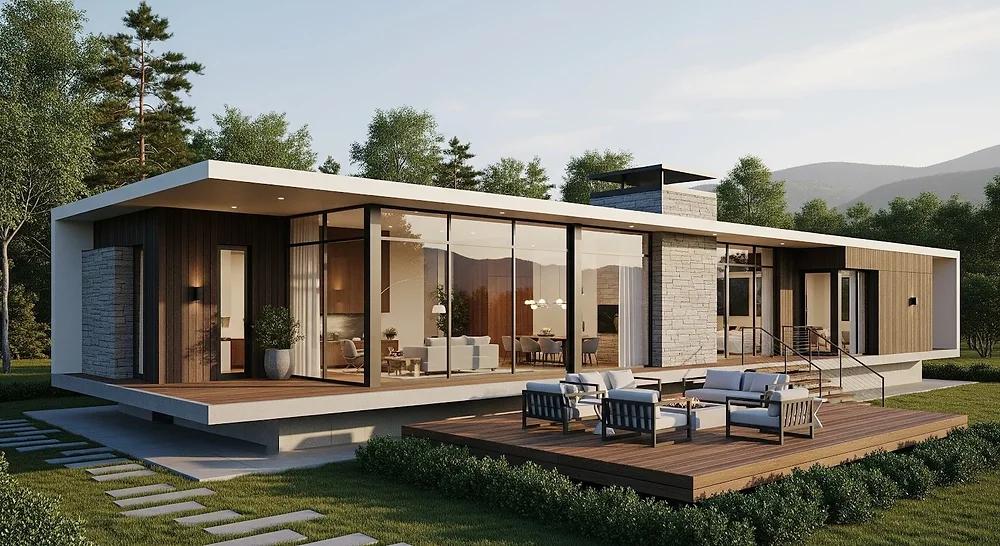
When choosing a new home, buyers increasingly have an alternative to conventional site-built construction: prefabricated and modular homes.
Modern prefab construction has moved far beyond the image of basic temporary buildings. Today's factory-built homes can feature architectural designs, premium finishes, large glazing systems, energy-efficient building envelopes, smart-home technology, luxury kitchens, designer bathrooms and highly customised floor plans.
For buyers considering a substantial investment, however, the important question is not simply “Is a prefab home cheaper?” The better question is:
The answer depends on the specific project, location, specifications, foundation, transportation, installation and level of customisation.
This guide compares prefab homes vs traditional site-built homes, explains the difference between prefab, modular and manufactured housing, and looks at where a premium modular solution from Fusion can provide additional design and customisation opportunities.

A prefabricated, or prefab, home is a building in which some or many components are manufactured away from the final building site and subsequently transported to the site for assembly.
Prefab is therefore an umbrella term, rather than one single construction method.
It can include:
This distinction is important because prefab does not automatically mean modular, and modular does not automatically mean manufactured housing.
The U.S. Department of Housing and Urban Development explains that modular homes are generally constructed in factories to applicable state and local building codes, whereas manufactured homes are constructed under the federal HUD Code.

One of the most common questions buyers ask is whether prefab and modular homes are actually different.
“Prefab” describes the construction approach. Parts of the building are produced away from the construction site.
A modular home is a specific type of factory-built construction where the building is manufactured in modules and transported to the site for final assembly.
Therefore:
Manufactured homes are another category of factory-built housing. In the United States, manufactured homes are constructed according to the federal HUD Manufactured Home Construction and Safety Standards and generally have a permanent chassis.
This distinction matters when considering:
Always confirm the regulations applicable to the exact site and product before ordering a home.

A traditional home is generally constructed substantially on the final property.
The construction process can involve:
The advantage is that virtually every element can be adjusted during construction.
The disadvantage is that the project can involve many different contractors, trades, deliveries and site-dependent variables.

| Factor | Prefab / Modular | Traditional Site-Built |
|---|---|---|
| Factory manufacturing | High | Low |
| Site construction | Reduced | Extensive |
| Construction schedule | Potentially shorter | Usually longer |
| Weather exposure during manufacturing | Lower | Higher |
| Design flexibility | High, depending on manufacturer | Very high |
| Customisation | Moderate to very high | Very high |
| Quality control | Factory-controlled processes | Primarily site-controlled |
| Transportation required | Yes | Materials transported individually |
| Foundation required | Usually | Usually |
| Site preparation | Still required | Extensive |
| Labour on site | Generally reduced | Generally higher |
| Cost predictability | Can be better | Can vary substantially |
| Luxury specifications | Available | Widely available |
| Planning/building approvals | Still required | Still required |
| Energy efficiency | Can be excellent | Can be excellent |
| Resale potential | Depends on construction and classification | Generally familiar to buyers |
There is no universal rule that prefab is always cheaper or that traditional construction is always more valuable.
The specification and total project cost matter more than the construction label.
Cost is usually the first consideration.
However, comparing only the advertised factory price against the price of a traditionally constructed home can produce a misleading result.
A proper comparison should consider the total installed project cost.
That can include:
For international projects, buyers should also understand whether the quotation is EXW, FOB, CIF, DAP or DDP.
A low factory price does not necessarily represent the final delivered cost.

One of the major advantages of factory-based construction is the ability to standardise and repeat manufacturing processes.
Instead of creating the entire building from scratch on an exposed construction site, components can be produced in a controlled environment.
Potential benefits include:
More work is completed before the building reaches the property.
Factories can use standardised processes, machinery and quality-control procedures.
Controlled manufacturing can help reduce unnecessary material handling and waste.
Site preparation and factory manufacturing may be performed simultaneously.
This can be one of the biggest advantages of modular construction.
While the foundation and site work are being prepared, the building may be progressing through manufacturing.
Factory production isn't exposed to rain, snow and other site conditions in the same way as conventional construction.
A basic prefab home can be highly cost-effective, but a luxury custom prefab home can cost as much as—or potentially more than—a conventional home with similar specifications.
Why?
Because premium specifications add significant costs.
For example, a luxury modular home might include:
The correct comparison is therefore:
Prefab vs traditional construction with equivalent specifications.
Not:
Basic prefab vs luxury site-built home.

Time is one area where modular construction can offer a significant advantage.
Traditional construction generally progresses sequentially.
For example:
Foundation → framing → roof → walls → services → interiors → finishing
Prefab construction can allow some processes to happen simultaneously.
For example:
Factory manufacturing + site preparation
can occur at the same time.
Once manufacturing is completed, modules can be transported to the site and assembled.
The U.S. Department of Energy has highlighted modular construction research showing that factory automation and advanced light-gauge steel framing can significantly improve production efficiency. One DOE project reported a 46% improvement in construction efficiency compared with conventional wood-framing methods in the studied manufacturing process.
This should not be interpreted as a guaranteed 46% reduction in the total project duration—actual schedules depend on design, approvals, site conditions, logistics and installation.
Traditional construction can be affected by:
A delay in one stage can affect multiple stages afterward.
Prefab can reduce some of these dependencies, but it does not eliminate project risk.
Planning approval, foundations, transportation, cranes and site installation can still create delays.

Another common misconception is that prefab means lower quality.
That isn't necessarily true.
Factory construction can provide controlled conditions for manufacturing and quality inspection.
Depending on the manufacturer, this can mean:
However, the manufacturer matters enormously.
A poorly designed prefab structure will not become high quality simply because it was manufactured in a factory.
Buyers should evaluate:
There is no automatic winner.
A traditionally built house can be extremely energy efficient, while a poorly specified prefab home can perform poorly.
The important factor is the building envelope and systems.
These include:
DOE research into modular construction has specifically investigated methods for improving energy performance through factory processes, insulation and building-envelope design.
Modern prefab construction can therefore be designed around high-performance energy efficiency rather than simply speed.
The long-term value of a prefab home depends on considerably more than whether it was manufactured in a factory.
Important factors include:
Land value and local property demand can have a major influence on overall property value.
A contemporary architectural design may have greater market appeal than a basic standardised structure.
Materials and engineering matter.
Local regulations can influence financing, insurance and resale.
A properly engineered permanent foundation can be important for the long-term performance of the building.
Lower operating costs can improve the overall attractiveness of a property.
Durable exterior materials and quality components can reduce future maintenance requirements.
A home designed for its specific site and market can have greater appeal than a generic structure.

Absolutely.
This is where the modern prefab industry has changed significantly.
Prefab does not have to mean:
Small + basic + temporary.
Modern modular construction can be used for:
Advanced designs can incorporate:
For buyers who want something beyond a basic modular building, Fusion can be positioned around the concept of premium, design-led prefab construction.
Instead of limiting the buyer to a standard box-shaped structure, the focus can be on creating a home around the client's:
Design the internal arrangement around how you actually live.
Contemporary façades, clean lines, extensive glazing and modern architectural forms.
Suitable structural systems can provide a robust framework for modern modular architecture, subject to project engineering and applicable regulations.
Premium flooring, kitchens, bathrooms, lighting and fixtures can transform a modular structure into a genuine luxury residence.
Insulation, high-performance windows, efficient HVAC and renewable-energy integration can be considered from the design stage.
Lighting, security, heating, climate control and other systems can be incorporated into an intelligent home design.
For suitable projects, solar PV and battery energy storage can be incorporated into the wider energy strategy.
Pergolas, terraces, outdoor kitchens, pools and other lifestyle features can be coordinated with the home design.
This creates an important distinction:
The goal isn't simply to buy a prefab house. The goal is to create a modern home using advanced prefab construction.
Traditional construction still offers enormous flexibility.
You can theoretically design almost anything that can be engineered and approved.
Prefab has historically been associated with standard designs, but modern manufacturers can offer increasingly sophisticated customisation.
The key question is:
Before purchasing, ask:
This is where a premium supplier can differentiate itself from a mass-market prefab provider.
One of the biggest mistakes when buying prefab homes is looking only at the advertised price.
A complete budget should consider:
The prefab price normally does not include the land.
The site may require excavation, levelling, drainage or other preparation.
The correct foundation depends on the engineering design and site conditions.
Large modules require specialist transportation.
Some projects require lifting equipment for installation.
Electrical, plumbing and other connections may require local professionals.
Requirements vary by location.
International projects may involve duties, taxes, customs clearance and local compliance.
Driveways, patios, gardens and external works are usually separate.
Water, electricity, gas, sewage and telecommunications may need additional work.
There isn't one answer for every buyer.
For many buyers, however, the decision isn't simply prefab OR traditional.
A sophisticated prefab project can combine factory precision with site-specific engineering, foundations, services and architectural customisation.

When comparing construction methods, don't focus exclusively on the initial purchase price.
Think about the entire ownership period.
Consider:
A slightly more expensive home with better insulation, efficient HVAC, durable materials and lower maintenance requirements could potentially deliver better long-term economics than a cheaper home with higher running costs.
Energy-efficient modular construction is an active area of building research, with DOE projects investigating factory automation, efficient envelopes and integrated building systems.
It can be, but it isn't always. The final cost depends on design, materials, size, transportation, foundation, installation, site work, utilities and local requirements.
The best comparison is between two homes with equivalent specifications.
Not exactly. Prefab is a broad term for factory-produced construction. Modular homes are one type of prefab construction.
Neither is automatically better. Modular homes can offer advantages in manufacturing efficiency, construction scheduling and quality control, while traditional construction can offer extensive flexibility.
A well-designed prefab home from a reputable manufacturer can be high quality. Quality depends on engineering, materials, manufacturing standards, installation and site work.
A properly engineered and maintained prefab home can be designed for long-term residential use. Longevity depends on the structure, materials, foundation, installation and maintenance rather than simply whether the home was factory-built.
Yes. The level of customisation varies between manufacturers. Premium prefab providers may offer custom floor plans, finishes, façades, windows, layouts and building systems.
Yes. Modern prefab construction can incorporate premium architectural designs, luxury interiors, large glazing systems, smart technology, energy-efficient systems and other high-end features.
The manufacturing period can be shorter than conventional on-site construction, but the complete project timeline also includes design, approvals, site preparation, foundation, manufacturing, shipping and installation.
Yes, provided the structure and electrical system are appropriately designed. Solar PV and battery storage can be considered during the design stage.
They can be. Energy performance depends on insulation, airtightness, windows, HVAC, ventilation, building orientation and other design factors. DOE research has demonstrated the potential for highly efficient modular construction.
Most permanent residential prefab and modular homes require an appropriately engineered foundation or support system. The exact solution depends on the building and site.
The answer depends on engineering, structural design, local codes, materials and site conditions. Buyers should request engineering documentation appropriate for their intended location.
Financing depends on the property's classification, location, lender and construction method. Modular homes built to applicable local building requirements can be treated differently from manufactured housing.
Manufactured homes in the United States are built according to the federal HUD Code and generally use a permanent chassis. Modular homes are generally constructed to applicable state and local building codes.
It can be. Many modular homes are designed as permanent residential buildings and installed on permanent foundations. The exact legal classification depends on the project location and construction method.
Fusion can offer premium prefab and modular solutions with a focus on architectural design, custom layouts, materials, finishes and additional features. The available specifications depend on the selected model and project requirements.
For suitable projects, a custom approach can be explored around the required dimensions, floor plan, architectural style, materials and features. A project quotation should be based on the actual site, specifications and delivery requirements.
Yes. These features can be planned as part of a broader luxury outdoor-living concept, although they may involve separate structural, planning, installation and site requirements.
Ask about:
Prefab and modular construction are increasingly important parts of modern construction because they can combine factory manufacturing, automation, standardisation and architectural design. DOE initiatives are actively investigating industrialised construction approaches for faster, more efficient and higher-performance buildings.
For buyers looking for a completely conventional, site-built home, traditional construction remains a proven option.
But for buyers looking for:
Modern architecture + faster manufacturing + controlled production + customisation + energy efficiency + luxury design, a premium prefab or modular home can be an extremely compelling alternative.
The biggest mistake is assuming that every prefab home is the same.
There is a significant difference between a basic factory-built structure and a custom-designed luxury modular residence.
That distinction is where Fusion can provide a stronger proposition.
Fusion focuses on bringing together modern prefab architecture, premium materials, customisable layouts and contemporary living solutions.
Whether you're looking for a compact modern residence, a luxury family home, a holiday property, guest accommodation or a larger bespoke modular structure, the right solution should be designed around the site, lifestyle, specifications and long-term objectives rather than simply selecting the cheapest available model.
Contact Fusion to discuss your requirements, preferred design, dimensions, specifications, delivery location and customisation options and request a tailored quotation.
Prefab homes vs traditional homes, modular homes vs traditional homes, prefab home cost, modular home cost, prefab construction, modular home construction, luxury prefab homes, modern prefab homes, custom modular homes
Suggested meta description:
Prefab vs traditional home explained. Compare construction costs, build time, quality, energy efficiency, customisation and long-term value before choosing your next home.
Important publishing note: For a commercial article aimed at U.S. buyers, keep the distinction between modular and manufactured homes precise. HUD specifically distinguishes modular homes from manufactured homes, so avoiding language that treats the terms as interchangeable will make the article more authoritative and reduce the risk of misleading buyers. Shop today

Als leidenschaftlicher professioneller Blog-Autor mit einer tiefen Liebe zur Mode ist das Schreiben über Fusion – die Marke, die ich bewundere – eine natürliche Erweiterung meiner Kreativität. Fusion repräsentiert mehr als nur Kleidung; es verkörpert eine einzigartige Mischung aus Stil, Kultur und Innovation. Mein Ziel ist es, die Essenz dieser modebewussten Marke durch ansprechende, aufschlussreiche Blog-Inhalte einzufangen. Indem ich Fusions neueste Kollektionen, Trends und Designphilosophien vorstelle, möchte ich Modebegeisterte erreichen und hervorheben, was diese Marke in der sich ständig weiterentwickelnden Modebranche auszeichnet.